
Missing Nausicaa
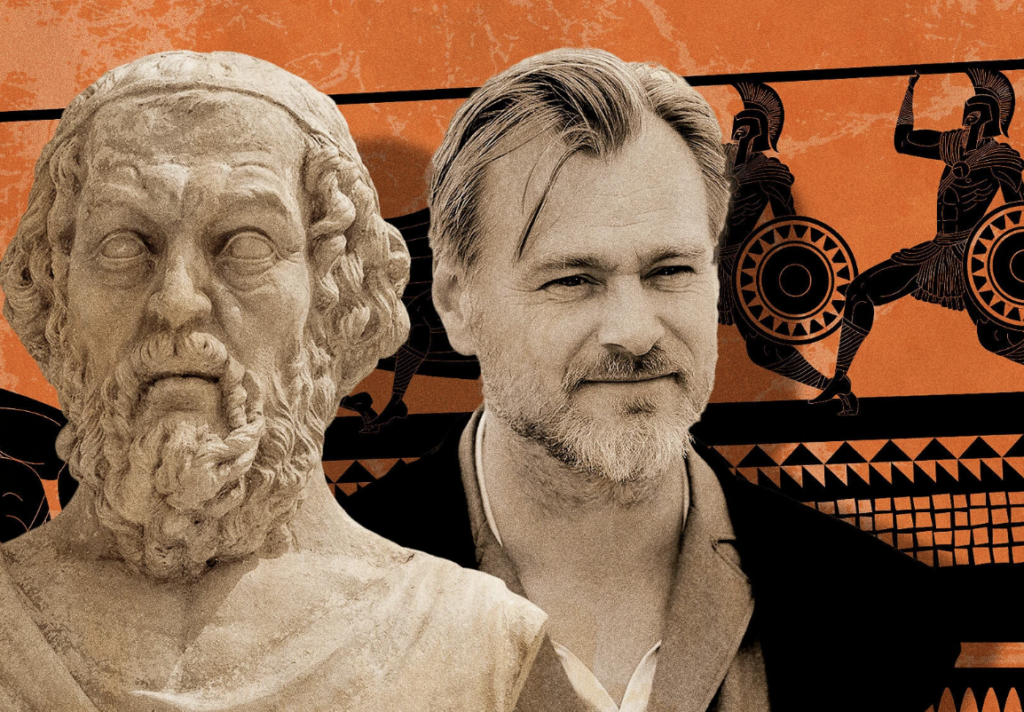
Homer and his follower Nolan ©: Time Out Author: Ewa Hess The Odyssey. The story of all stories. More modern than ever. It tells the tale of displacement and war, of men and women who use their wits and spirit under unfriendly skies. Andra moi ennepe, Musa… Now comes Nolan, the man unafraid to turn the Dark Knight (Lucifer himself?) and the atomic bomb (the Lucifer of our times?) into sombre, memorable pieces of entertainment, reaching out for ‘the story’. How can we see and judge a piece like that? OK, I admit it: Christopher Nolan’s take on Homer’s great tale is pleasing to the eye and does not lack passion, sorrow or villainy. But am I alone in this? After three hours of unquestionably grand IMAX vision, I left the cinema in the dark, overcome by an inexplicable hunger. I couldn’t pinpoint it at first. After a night’s sleep, I had one thought: Where was Nausicaä? And where was her ball? Not a weapon. Not a ship. Not the bow that only Odysseus can string. Just a girl’s ball, meant for playing with her girlfriends on the beach. But on the screen, princess Nausicaä is gone. There is not a trace of her in Christopher Nolan’s long, rich film. In Homer’s tale, the princess does not appear as a reward or a temptation, but as a young woman who is almost still a child, playing with her friends on the shore. A ball arcs through the air. Someone misses the catch. Laughter turns into cries. The cries wake the shipwrecked stranger. The scene is so light-hearted that it almost seems to belong in a different poem. Or perhaps it belongs precisely here. I found myself thinking of Huizinga’s Homo Ludens. He argued that culture begins in play. Homer never says as much. He simply lets the girls play and changes the tone in an instant. It is one of those seemingly insignificant moments. And yet, remove it and something subtle changes. Not the plot. The climate. Nolan’s film is full of passion and stern conviction. Every encounter carries the weight of destiny. Every silence begs to be interpreted. Even Calypso’s erotic island is tinged with melancholy. With Homer, however, the story is different. Odysseus knows he must leave. He has already started to build his raft. Ithaca is no longer a dream, but a destination. Nevertheless, he spends one last night with Calypso — and enjoys it all the more. No oblivious lotus flower is needed. There is no psychological explanation. Homer gives his hero something that I missed in the well-aerated IMAX: the freedom of ambivalence and a desire for tenderness, which he is already leaving behind. Our time is no less scary than it was for the ancient Greeks. We have wars, emigration and an increasingly unpredictable nature — the more we try to control it, the more unpredictable it becomes. But we prefer scientifically explained motives to wonders and mysteries; we eagerly diagnose trauma or PTSD; and we have little space for unexplainable contradictions. Homer rarely seems interested in explaining people. He observes them. He tells their tales as they are: People feast, make love and wage war. They weep at a song. They invent stories. They flirt. They sleep. They play. Perhaps this is why the missing princess Nausicaä matters. Not because she is essential to the story, but because she reminds us that civilisation is measured not only by what people are willing to die for, but also by how they choose to spend their time while they are alive. Zurich, 20.7.2026