
Festival

Fiction goes Nyon

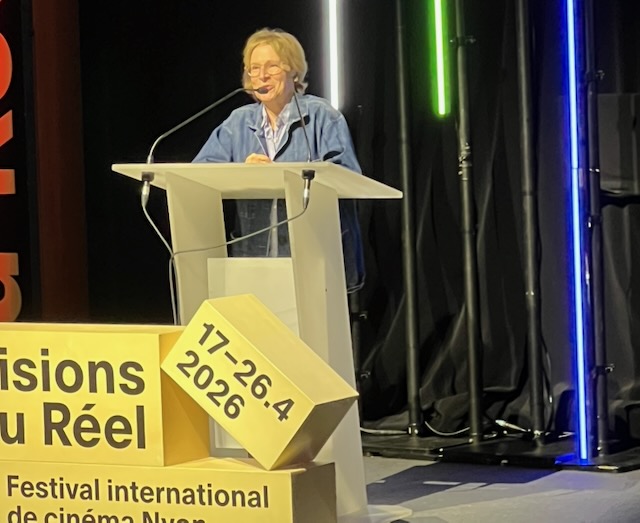
What is a fiction film doing at one of Europe’s most important documentary festivals? The question inevitably arose when Kelly Reichardt’s The Mastermind appeared in this year’s programme of Visions du Réel. Set in Massachusetts in 1970, it follows an amateur art thief who stumbles through a poorly conceived robbery. There are actors, a script, carefully composed scenes—everything that would traditionally place the film outside the documentary field. And yet, after ninety minutes in Reichardt’s company, the distinction begins to feel surprisingly irrelevant. Perhaps this is because Visions du Réel has gradually ceased to define itself as a festival of documentaries in the narrow sense. Over the years, it has become something more ambitious: a place where cinema is valued for the way it approaches reality rather than for the production methods behind it. The real is not guaranteed by the absence of actors. It emerges through a certain attention to the world. Kelly Reichardt has practised that attention for more than thirty years. She has often been described as the great minimalist of American independent cinema, but the label is misleading. Her films are not minimalist because little happens. They are minimalist because she refuses to tell us where to look. Meaning is never imposed. It accumulates slowly, through gestures, pauses, landscapes, conversations that drift without obvious dramatic purpose. Watching a Reichardt film resembles watching a documentary whose participants happen to know the outline of the story. The Mastermind disguises itself as a heist movie, but almost immediately abandons the pleasures normally associated with the genre. Suspense dissolves into waiting. The robbery itself matters less than the circumstances surrounding it: the atmosphere of a country fractured by the Vietnam War, suburban routines, economic uncertainty, the quiet exhaustion of ordinary lives. The camera remains attentive to rooms, streets, weather and silence with the same patience that characterises observational documentary. Nothing insists on becoming symbolic. Everything is allowed simply to exist. This is where Reichardt’s cinema reveals its documentary affinity. Her films never seem interested in illustrating ideas. They observe situations until meaning gradually emerges from the material itself. Houses, clothing, trees, empty parking lots and hesitant conversations possess the same importance as the protagonists. The world is never reduced to a backdrop for narrative. One senses that reality is continuously resisting the screenplay—and that Reichardt welcomes this resistance instead of correcting it. There is also an ethical dimension to her filmmaking. Reichardt refuses the spectacular, even when genre conventions invite it. Violence remains awkward rather than exciting. Failure is never romanticised. Characters are neither heroes nor villains but individuals trying, often unsuccessfully, to navigate historical forces larger than themselves. It is an approach that recalls the best documentary practice: refusing easy judgement while trusting the viewer’s intelligence. In this sense, The Mastermind does not stretch the identity of Visions du Réel. It clarifies it. Contemporary documentary festivals increasingly understand that the most interesting division in cinema is no longer between fiction and non-fiction. The more meaningful distinction lies elsewhere: between films that manipulate reality into ready-made narratives and films that remain genuinely curious about the world’s complexity. Reichardt belongs unmistakably to the latter category. That is perhaps why her work felt so completely at home in Nyon. Not because The Mastermind pretends to be a documentary, but because it shares documentary’s deepest ambition: to make us look again at what we thought we already knew. Perhaps that is what Visions du Réel wanted to celebrate by inviting Kelly Reichardt as its guest of honour. Not a filmmaker who crosses the border between fiction and documentary, but one who quietly demonstrates that, for the most attentive cinema, the border has never mattered very much. The most documentary gesture in The Mastermind is that it never claims to possess reality. It simply observes until fiction acquires the density of lived experience. In a festival devoted to the cinema of the real, that proved not to be a contradiction, but a reminder of what cinema, at its finest, can still do. Nyon goes fiction? No. It is the masterfull fiction going Nyon.

Fiction goes Nyon Read More »

Clooney in Berlin

Clooney in Berlin Ewa Hess | 9. Februar 2014 – 20:05 Wie konnte das so gründlich schiefgehen? Es ist George Clooneys sechster Film als Regisseur, und alle anderen waren gut. Dieser eine, «Monuments Men», der gestern an der Berlinale erstmals gezeigt wurde, ist aber ein Blindgänger. Am Schluss der Pressevorführung gab es Pfiffe. Für Clooney! In Berlin! Dabei hat die Stadt dem Film, der um die Ecke in den Babelsberg-Studios gedreht wurde, so entgegengefiebert wie selten einem. Deutsche Vergangenheit in den Händen des Filmästheten – das konnte doch nur ein Hit werden. Doch so entschlossen alle waren, den Film über tapfere «Monuments Men», also eine Spezialtruppe der US-Kunstretter, gut zu finden, es ging nicht. Am Ende war es im rappelvollen grossen Saal des Berlinale-Palasts klar: Der einzige Moment echter Betroffenheit war, als ein Kollege mitten in der Vorführung einen Herzinfarkt erlitt und der Film angehalten werden musste. Eigentlich hat der Film alles für einen Blockbuster Dabei hat die Geschichte über ein Trüppchen US-Intellektueller, die in der letzten Phase des Zweiten Weltkriegs ihr Leben aufs Spiel setzen, um die von den Nazis geraubten Kunstwerke vor Vernichtung und Plünderung zu retten, eigentlich alles, was ein Blockbuster braucht. Erstens eine All-Stars-Besetzung, die ihresgleichen sucht. Da ist erst mal Clooney als kunsthistorischer Indiana Jones, ein Professor, der sich in einen Abenteurer wandelt. Mit von der Partie ist auch Matt Damon, mit den aus der «Bourne»-Serie bekannten imposanten Muskeln, der unbezahlbare Bill Murray mit seiner stoischen Miene, der lustige Choleriker aus «Big Lebowski», John Goodman, der charmante «Artiste» Jean Dujardin, dazu noch unser Schweizer Nachwuchstalent Joel Basman und, um dem ganzen Würze zu verleihen, die bezaubernde Cate Blanchett als eine Pariser Bilderwärterin mit Brille. Nicht dass der Film langweilig wäre. Es ist eher, als ob es gar kein Film wäre, sondern eine Abfolge von Sketches, die nicht zu einer Erzählung zusammenwachsen. John Goodman hat im ganzen Film vielleicht zwei witzige Zeilen. Die erste ist ganz am Anfang, als sich die Architekten, Restaurateure und Designmuseumsdirektoren auf den Kriegseinsatz vorbereiten und er meint, dass mit Blindmunition geschossen wird, dabei ist es echte. So geht es die ganze Zeit. Nicht nur mit dem Humor. Auch mit der Romantik. Cate Blanchett etwa spielt im Film Claire, die Frau, die während der ganzen Besatzungszeit in Paris das Raubkunstlager der Nazis im Museum Jeu de Paume heimlich von ihrer Position als Sekretärin überwacht und katalogisiert. Damit sie den Amis verrät, wo die Nazis den Genter Altar und die Brügger Madonna lagern, muss Damon sie erst überzeugen, dass die «Monuments Men» die Kunstwerke nicht selbst klauen. Kaum ist ihm das gelungen, öffnet sie ihren strengen Dutt und lädt ihn zum Essen ein. Sehr subtile Symbolik. Dabei hat Clooney, der Frauenschwarm, bisher mit jedem seiner Filme bewiesen, dass zwischen seinen attraktiven Silberschläfen mehr Hirn steckt, als die meisten Männer neidvoll vermuten. Die Filme waren alle gut – und jeder von ihnen machte sich für eine Tugend stark. Denn darin ist Clooney ganz der traditionelle Mann aus den Südstaaten, mit einem warmen Empfinden für Recht und Anstand (ausser mancher seiner Freundinnen gegenüber). In «Confessions of Dangerous Mind» geisselte er – visionär – den Zynismus der US-Geheimdienste. In «Good Night, Good Luck» machte er sich für die Pressefreiheit stark, in «The Ides of March» liess er einen politischen Ränkespieler scheitern. Bei «Monuments Men» muss dem grossen Liebhaber europäischer Kultur, die er so gerne in seiner kultivierten Villa am Comersee feiert, ein Übermass an Respekt im Weg gestanden haben. Man sieht es direkt vor sich, wie Clooney vor all diesen Rembrandts, Renoirs, Cézannes und van Eycks in Ehrfurcht erstarrt – und seinen Film vergeigt. «Monuments Men» ab 20. Februar 2014 bei uns im Kino About Ewa HessSwiss journalist, Editor Arts @Sonntagszeitung, ZürichView all posts by Ewa Hess » @askewa @PSPresseschau Wunderbares textlein 🍀 thx 4 sharing 08:10:37 PM Mai 30, 2023 von &s in Antwort auf PSPresseschau@GESDA Hackathon 4 the future – Open Quantum Institute in the making. Impressive! https://t.co/hWBdlsEFkd 09:35:19 AM Mai 07, 2023 von &s in Antwort auf GesdaIt’s my #Twitterversary! I have been on Twitter for 13 years, since 26 Nov 2009 (via @twi_age). 01:00:51 AM Dezember 13, 2022 von &s @askewa folgen Neueste Beiträge Baselitz‘ WeltI likePrivate Sales, ein SchattenspielAdieu John BergerTalk mit Jacqueline Burckhardt Blogroll FAQNews-BlogPop MattersRevue 21Support ForumWordPress-Planet Themen Ai Weiwei Amerika Andy Warhol Aphrodite Ascona Baron Heinrich Thyssen Basel Biennale Venedig Bird’s Nest Caravaggio China Fischli/Weiss Fondation Beyeler Frank Gehry Georg Baselitz Gerhard Richter Ghirlandaio Gstaad Gurlitt Gustav Klimt Harald Szeemann Keanu Reeves Kunst Kunstmuseum Basel Louise Bourgeois Maja Hoffmann Maria Lassnig Marlene Dumas Melinda Nadj Abonji Monte Verità Nachtkritik Oprah Winfrey Pipilotti Rist Schweizer Architektur Schweizer Film Schweizer Kunst Schweizer Literatur Shakespeare Simon de Pury Thomas Hirschhorn Ugo Rondinone Urs Fischer Valentin Carron Warhol Weltwoche Previous PostNext Post Schreibe einen Kommentar Cancel Reply Logged in as Ewa Hess. Edit your profile. Log out? Required fields are marked * Message*

Clooney in Berlin Read More »